A factory manager in Katunayake glances at a dashboard. An AI model just predicted a 30% spike in demand for sustainable activewear in Germany, automatically adjusting the production line before a human even saw the purchase order. This isn’t a scene from the future; it’s happening right now across Sri Lanka’s top apparel firms.
I think this is where the story gets really fascinating. We’re seeing predictive analytics completely reshape the industry, helping giants like MAS and Brandix forecast trends with incredible accuracy and optimize every inch of fabric. It’s a massive competitive advantage, pushing export numbers to new heights. We’ve moved beyond simple automation into an era where data dictates every single stitch.
But here’s the uncomfortable truth we need to discuss. For every AI optimizing a supply chain, what happens to the person who used to manually manage inventory or check simple seam quality? This boom has a flip side: the steady erosion of traditional, routine factory jobs. In this piece, we’ll get real about this double-edged sword, looking at exactly which roles are disappearing and what new skills are becoming essential for survival.
The AI-Powered Boom: How Predictive Analytics is Reshaping Sri Lankan Apparel
For years, the story of Sri Lankan apparel was all about skilled hands and competitive labor costs. That’s still part of the picture, but I think the real story now is happening on servers, not just on the factory floor. The country’s top manufacturers are making a serious bet on predictive analytics, and it’s paying off by transforming them from simple producers into incredibly responsive supply chain partners. They’re not just sewing faster; they’re thinking faster.
From Social Media Trends to Production Runs
So, how does this actually work? Well, imagine an AI that constantly scans TikTok, Instagram, and fashion blogs. It’s not looking at cat videos; it’s performing sentiment analysis to identify which colors, silhouettes, and fabrics are about to go viral. A Sri Lankan factory can use this data to predict, with surprising accuracy, that a specific shade of “millennial pink” is about to be replaced by “Gen-Z green.” They can then advise their clients—major brands in Europe and the US—and adjust their material orders before a formal purchase order even arrives. This proactive approach is a massive shift from the old model of just waiting for instructions.
Optimizing Every Yard of Fabric
The intelligence extends right down to the production line. AI-powered algorithms are optimizing supply chains, figuring out the absolute fastest and cheapest way to get raw materials from China or India to a factory in Biyagama. On the factory floor, computer vision systems are a huge deal. These are high-speed cameras that inspect fabric for defects, catching tiny flaws the human eye might miss. One factory I read about managed to reduce its material waste by over 15% this way. When you’re dealing with millions of meters of fabric, that’s a colossal saving. For a brand like Nike or Victoria’s Secret, this means faster turnarounds and higher quality consistency. What’s not to love about that?
I think the best way to picture the advantage is with a simple scenario. A major UK retailer suddenly needs an extra 50,000 units of a blouse because of an unexpected heatwave. In the past, this would cause chaos. Today, a Sri Lankan producer can use its AI platform to instantly recalculate production schedules, re-allocate resources, and confirm the new order within hours. Their competitors in countries slower to adopt this tech might take days to do the same math, by which time the opportunity is gone. It’s a genuine competitive edge built on data, not just lower wages.
The Human Cost: Automation and the Decline of Routine Factory Jobs
Building on that foundation of AI-driven efficiency, there’s a side to this story we absolutely have to talk about. I think it’s easy to get excited about export numbers and forget that these factories are powered by people. For every predictive algorithm optimizing a supply chain, there’s a potential real-world consequence on the factory floor. And honestly, that’s where the shine of this tech boom starts to wear off.
The jobs being phased out are the very ones that have been the backbone of Sri Lanka’s apparel industry for decades. We’re not talking about a few isolated roles; we’re seeing a systemic shift away from manual, repetitive tasks. Think about the core of a garment factory:
Manual Fabric Cutters: They are being replaced by automated spreading tables and computer-guided cutting machines, like those from Gerber or Lectra, which can cut with precision and speed no human can match.
Sewing Machine Operators: While complex sewing still requires a human touch, a lot of basic assembly work—stitching straight seams, attaching pockets—is being handed over to robotic arms and specialized automated sewing units.
Quality Assurance Inspectors: The job of visually checking every garment for defects is increasingly done by high-speed camera systems running vision AI. These systems don’t get tired and can spot a missed stitch in a millisecond.
Packaging Line Workers: The final folding, bagging, and boxing of garments is a prime target for automation, with machines now handling the entire process.
A recent forecast I saw from the Joint Apparel Association Forum (JAAF) was pretty sobering. They estimated a potential reduction of 40,000 to 50,000 of these routine operational roles by 2030. That’s a huge number in an industry that employs hundreds of thousands, many of whom are women from rural areas.
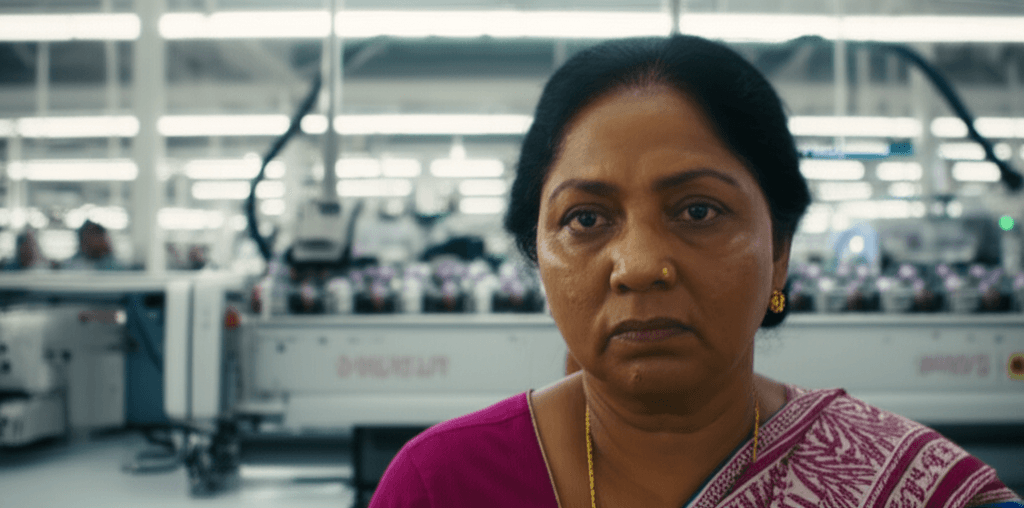
Let me paint a picture for you. Imagine a woman named Kamala, who is 45 years old. She’s spent the last 22 years operating a single-needle lockstitch machine in a factory outside Katunayake. Her skill is muscle memory; she can guide fabric with her eyes closed. That job put her children through school and supported her elderly parents. One day, her line is replaced by a new automated system. She’s offered a “retraining program” to become a machine maintenance assistant, but the technical skills are completely alien to her. After two decades of mastering one specific craft, starting over feels impossible. Her story isn’t unique; it’s an archetype for thousands. So, as we celebrate the economic wins, who is responsible for catching people like Kamala before they fall?
Bridging the Gap: The Rise of New Roles and the Need for Reskilling
Here’s what really matters though. While the headlines understandably focus on the jobs being lost, I think that’s only half the story. The other, more hopeful half is about the entirely new jobs this technology is creating. This isn’t just about replacing people; it’s about reconfiguring what a factory job even looks like.
We’re talking about roles that didn’t exist five years ago. Think about it: who keeps the predictive AI running smoothly? You need AI System Supervisors to monitor the algorithms and ensure they’re not making bizarre suggestions. When a robotic arm on the cutting floor malfunctions, you need a Robot Maintenance Technician, not a mechanic with a wrench, but someone who understands circuitry and software. And what about all that data? Factories now need Data Analysts who can translate sales forecasts and social media trends into actual production plans. The entire logistics chain is going digital, creating a need for Digital Supply Chain Managers who can track a garment from a cotton field to a customer’s doorstep in real-time.
The challenge, of course, is the massive skills gap. The muscle memory of a master seamstress is incredible, but it’s a completely different skill set from interpreting a data dashboard that predicts what color will be in vogue next season. This isn’t a small step up; it’s a leap across a chasm. So, how do you help people make that leap?
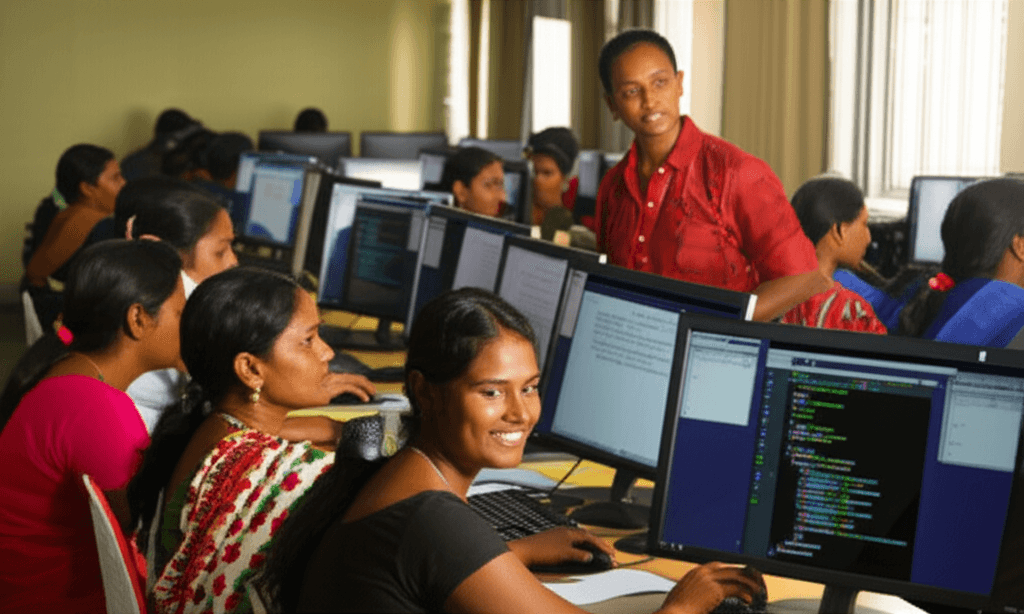
Some of the big players are already trying to build that bridge. I’ve seen reports about initiatives like the “Future-Fit Factory Program,” a partnership between a major apparel group like MAS Holdings and the Sri Lanka Institute of Textile & Apparel (SLITA). They identify high-potential line workers and put them through intensive six-month reskilling bootcamps. For example, a quality control inspector who used to spot defects by eye is retrained to become a Predictive Quality Analyst. They learn to use software that analyzes sensor data from the machines to flag potential errors before they even happen. It’s a move from reactive to proactive work, and it requires analytical thinking. It’s a huge undertaking, no doubt. But what’s the alternative, letting a generation of skilled workers get left behind?
The Path Forward: Policy, Investment, and a Sustainable Future
So, we’re at a crossroads. On one hand, we have this incredible boom in exports, driven by smart technology. That’s fantastic for Sri Lanka’s economy. On the other hand, we have the very real human cost of job displacement for factory workers. I think the big question isn’t whether we should use AI, but how we manage its integration so that everyone benefits. It’s a challenge, for sure, but definitely not an impossible one if we’re smart about it.
Rethinking the Role of Government
This is where policy has to step up, and not with vague promises. I’m talking about a focused, three-part strategy. First, we need dedicated funding for vocational tech training. This isn’t about generic computer skills; it’s about creating programs that teach digital pattern-making, supply chain analytics, or how to operate the very AI systems being deployed. Second, a stronger social safety net is essential. Imagine a ‘transitional unemployment benefit’ directly linked to enrollment in one of these new skilling programs. This provides a financial cushion while preparing people for their next role. Finally, the government could offer meaningful tax incentives to companies that can prove they are reskilling their workforce, not just replacing them. You could even measure success using an established framework, like the Kirkpatrick Model, to ensure the training actually leads to on-the-job performance.
A New Chapter for Corporate Responsibility
Honestly, this can’t all be on the government. The apparel giants have a huge role to play. Corporate social responsibility needs to evolve beyond just building a school or planting trees. It must now include the ethical implementation of technology. I believe the most forward-thinking companies will see their people as an asset to be developed, not a cost to be minimized. For example, instead of laying off an entire floor of sewing machine operators, a company like Brandix could identify individuals with aptitude and retrain them. A former line supervisor could become an AI systems monitor, ensuring the predictive models are running correctly. A detail-oriented sewer could be retrained as a quality assurance specialist, using AI-generated reports to spot complex defects that automated systems might miss.
Pairing Human Ingenuity with Machine Efficiency
The best-case scenario isn’t a factory devoid of people. It’s one where human talent is amplified by technology. Let AI handle the drudgery—the demand forecasting, the inventory management, the optimization of fabric cutting. This frees up human workers to focus on what we do best: creativity, complex problem-solving, and building relationships. Think of designers collaborating with AI to test thousands of variations in minutes, or merchandisers using predictive insights to negotiate better deals with global brands. Isn’t the ultimate goal an industry that’s not just more profitable, but also more innovative and human-centric? It’s a tougher path, but it’s the one that builds a truly resilient future.
Where Do We Go From Here?
So, it’s a classic double-edged sword, isn’t it? On one hand, AI is making Sri Lanka’s apparel exports incredibly competitive, which is fantastic for the national economy. But on the other, we’re seeing those routine factory floor jobs decline. I think the real point here isn’t just that ‘technology is changing things’—we all know that. It’s that we have to be intentional about managing the human side of this progress. This isn’t about fighting technology, but about actively preparing our workforce for the new skills required. Sharing this article is a small step to raise awareness and get more people talking about building a fair future. It leaves me wondering…
How do we ensure the very people who built this industry are part of its future, not casualties of it?
Frequently Asked Questions
What is predictive AI in the apparel industry?
Predictive AI uses algorithms to analyze historical data, market trends, and consumer behavior to forecast future demand, optimize supply chains, reduce waste, and predict production issues before they happen.
Are all factory jobs in Sri Lanka's garment sector at risk?
Not all jobs. Routine, repetitive tasks are most at risk of automation. However, new roles requiring technical skills, creativity, and strategic oversight are emerging, creating a critical need for workforce reskilling.
What can be done to help displaced garment workers?
A combination of government-led social safety nets, corporate-sponsored reskilling programs, and investment in vocational training focused on digital literacy and technical skills can help workers transition to new roles in the evolving industry.