Picture this: you’ve just pushed your beautiful, single-page application live. It’s built with React, the user experience is fluid, and the team is celebrating. A week later, you check Google Search Console and your heart sinks. Only the homepage is indexed, and performance reports are a sea of red. You’re invisible to your most important source of traffic.
This isn’t a hypothetical scenario. I’ve seen this exact panic play out on projects that went all-in on Client-Side Rendering (CSR) without fully considering the SEO implications. Your choice between rendering on the server (SSR) or in the browser is one of the most significant architectural decisions you’ll make for organic performance. It directly impacts how easily search engine bots can see, process, and ultimately rank your content.
So, let’s move beyond the theoretical arguments. We’re going to compare these two methods on the metrics that actually move the needle for your rankings—from initial crawl budget and indexing speed to First Contentful Paint and Core Web Vitals. By the end, you’ll understand the trade-offs and have a clear framework for deciding which approach will give your content the visibility it deserves.
Understanding Rendering: Why It’s a Game-Changer for SEO
I once spent an entire afternoon assembling a flat-pack coffee table. The box contained a jumble of wood panels, screws, and a cryptic instruction manual—just raw materials. The finished table only existed after I did the work. Web rendering is a lot like that. Your browser receives code—HTML, CSS, and JavaScript—and must assemble it into the interactive webpage you see and use. Without this assembly process, it’s just a meaningless pile of code.
Now, imagine Googlebot arriving at your page. It doesn’t have an afternoon to spare. It needs to see that finished coffee table, not the box of parts. If your site sends a mostly empty HTML file that relies heavily on JavaScript to build the page inside the user’s browser, Google has to do that assembly work, too. This second wave of processing can cause delays or even failures, meaning the bot might miss your content entirely.
This is where the two main approaches diverge.
Server-Side Rendering (SSR) is like getting the coffee table delivered pre-assembled. The server does the work, sending a complete HTML page that the browser can display immediately.
Client-Side Rendering (CSR), common with frameworks like React and Vue, is the flat-pack model. The browser gets a basic shell and a lot of JavaScript ‘instructions’ to build the page on its own.
The core SEO conflict lies right here. SSR delivers a fast, fully-formed page that search engines can easily crawl and index. CSR can create incredibly rich, app-like user experiences, but it often comes at the cost of that initial crawlability and load speed. It’s a fundamental trade-off between what the bot sees first and what the user can do later.
Server-Side Rendering (SSR): The SEO-Friendly Traditionalist
I remember staring at a blank white screen for what felt like an eternity, waiting for a travel blog post to load. All I saw was a spinning loader icon. That initial delay, that moment of nothingness, is a user experience killer. This brings us to something often overlooked: what a search engine crawler sees during that same moment.
With Server-Side Rendering (SSR), there is no blank screen. Think of it as old-school web development supercharged for the modern era. When your browser requests a page, the server does all the heavy lifting. It fetches data, runs the necessary JavaScript, and assembles a complete, fully-formed HTML document before sending anything back. It’s like getting a pre-assembled piece of furniture delivered to your door. Frameworks like Next.js for React or Nuxt for Vue have made this process incredibly sophisticated.
For a search bot, this is a dream come true. Googlebot receives a finished page on its first request, allowing it to immediately see and index all your content. This immediate crawlability is a massive SEO advantage. It also directly improves key performance metrics. Your First Contentful Paint (FCP) is quick because meaningful content is right there in the initial payload. For an e-commerce site, this means the product image and title—often the Largest Contentful Paint (LCP)—render almost instantly, which Google’s ranking algorithms favor.
But this front-loaded work comes at a cost. Because the server is busy building the page, the Time to First Byte (TTFB) can be slower. It’s a trade-off: you wait a little longer for the first piece of data, but then you get the whole finished product at once. This can also lead to higher server costs, as your server is doing more computation for each user request.
Client-Side Rendering (CSR): The Modern, Interactive Approach
I remember the first time I used a project management tool built with React. A single loading spinner appeared, and then everything was there. Clicking between boards and tasks was instantaneous, with no white-screen flashes between pages. It felt like a desktop application, not a website. That magic is the promise of Client-Side Rendering.
Let’s shift gears for a moment and look under the hood. With CSR, your server doesn’t send a fully formed HTML document. Instead, it sends a very basic HTML shell—often just a single `<div>`—and a hefty bundle of JavaScript. Your browser then takes on the role of a builder, executing that script to construct the page right before your eyes.
For a user, that initial wait is rewarded with a wonderfully fluid experience. For a search engine crawler, it’s a different story. This is where we run into what SEOs call the ‘two waves of indexing.’
First Wave: Google’s crawler initially fetches the HTML and sees that nearly blank page. It indexes what it can (which is almost nothing) and makes a note to come back later.
Second Wave: When resources are available, Google returns to execute the JavaScript, render the full page, and finally index the actual content.
This delay between waves can mean your content sits in search limbo, invisible for days or even weeks. Worse, if the JavaScript fails or times out—a real risk with complex applications—Google might give up. I’ve seen cases where critical product details were completely missed by crawlers because they were buried in a script that didn’t execute properly for the bot. The result is a fantastic user experience that, from an SEO perspective, might as well not exist.
Head-to-Head SEO Breakdown: SSR vs. CSR
I remember a client launch years ago for an e-commerce brand. They had just rebuilt their site using a shiny new client-side framework. The week after launch, their organic traffic fell off a cliff. Panic set in. The site looked beautiful to users, but to Googlebot, it was a ghost town of empty HTML shells. It was my first hard lesson in how rendering choices can make or break your SEO. We eventually fixed it, but that experience shaped how I approach this conversation.
When we put these two methods in the ring, the fight often comes down to who gets their content to the search engine first and most reliably. Let’s break it down.
Crawling and Indexing Speed
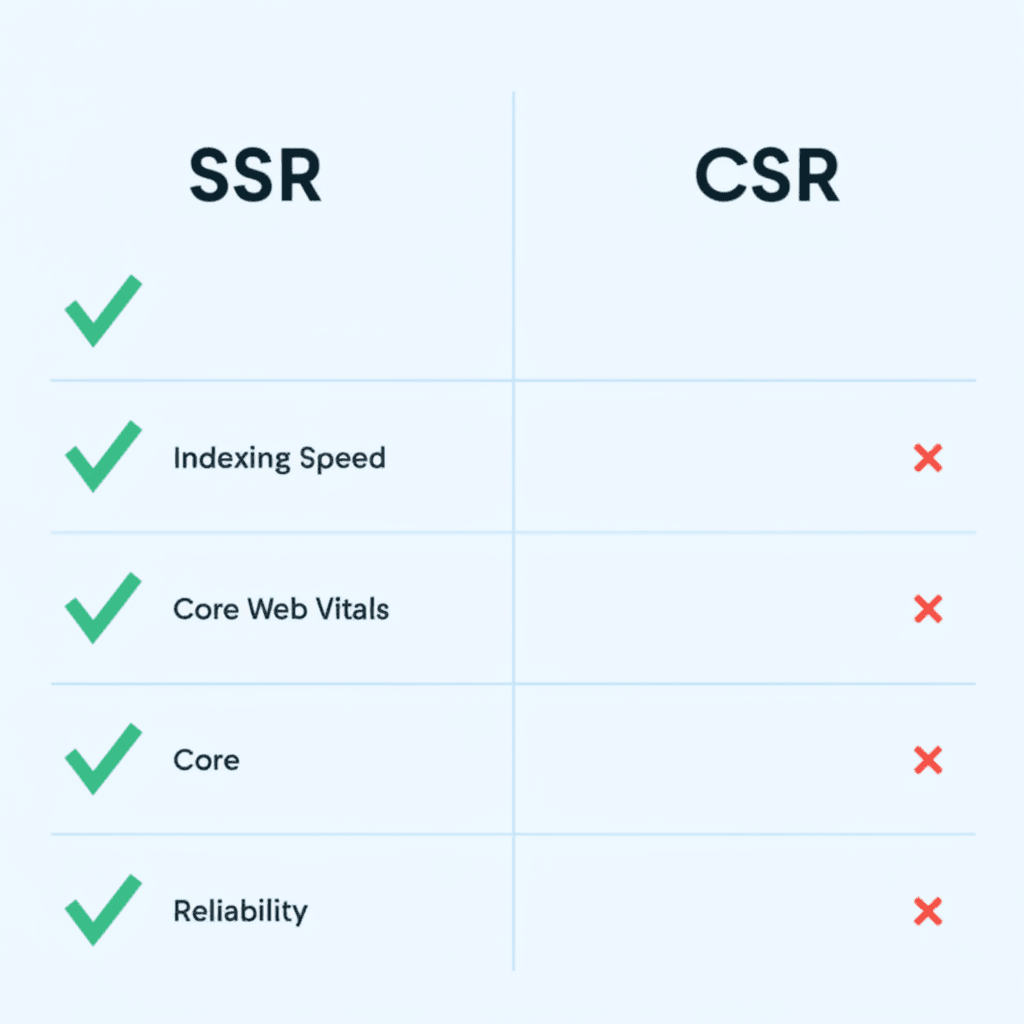
Server-Side Rendering wins this round, and it’s not even close. With SSR, the server sends a fully-formed HTML document to the browser and the bot. Googlebot receives a complete page, ready for immediate parsing and indexing. It’s clean and efficient. Client-Side Rendering, on the other hand, sends a nearly empty HTML file with a bundle of JavaScript. Googlebot has to execute that JavaScript to see the final content, a process that happens in a second wave of indexing. This adds delay and introduces a point of failure; if the script breaks, Google sees a blank page. Verdict: SSR is the clear winner for speed and reliability.
Core Web Vitals
This is more nuanced. SSR typically delivers a faster Largest Contentful Paint (LCP) and First Contentful Paint (FCP) because the main content is baked into the initial HTML response. There’s no waiting for JavaScript to download and run. However, once a CSR application is loaded, subsequent navigation can feel instantaneous, potentially leading to a better Interaction to Next Paint (INP). The user isn’t waiting for a full round trip to the server for every click. Still, that initial load is what search engines scrutinize most heavily. Verdict: SSR wins for the critical initial load metrics that heavily influence rankings.
Choosing Your Path: Hybrid Solutions and the Final Verdict
I remember a meeting years ago where a marketing director and a lead developer were at a complete standstill. One demanded the instant load times and perfect SEO of a traditional site; the other wanted the rich interactivity of a modern web application. They saw it as an impossible choice. The good news is that this specific battle is largely over, and today, you rarely have to choose one over the other.
The conversation has moved beyond a simple binary. Modern frameworks have gifted us a powerful middle ground, blending the raw performance benefits of SSR with the dynamic user experience of CSR. These hybrid approaches are now the standard for a reason.
The Modern Toolkit
Instead of one path, you now have a few sophisticated options:
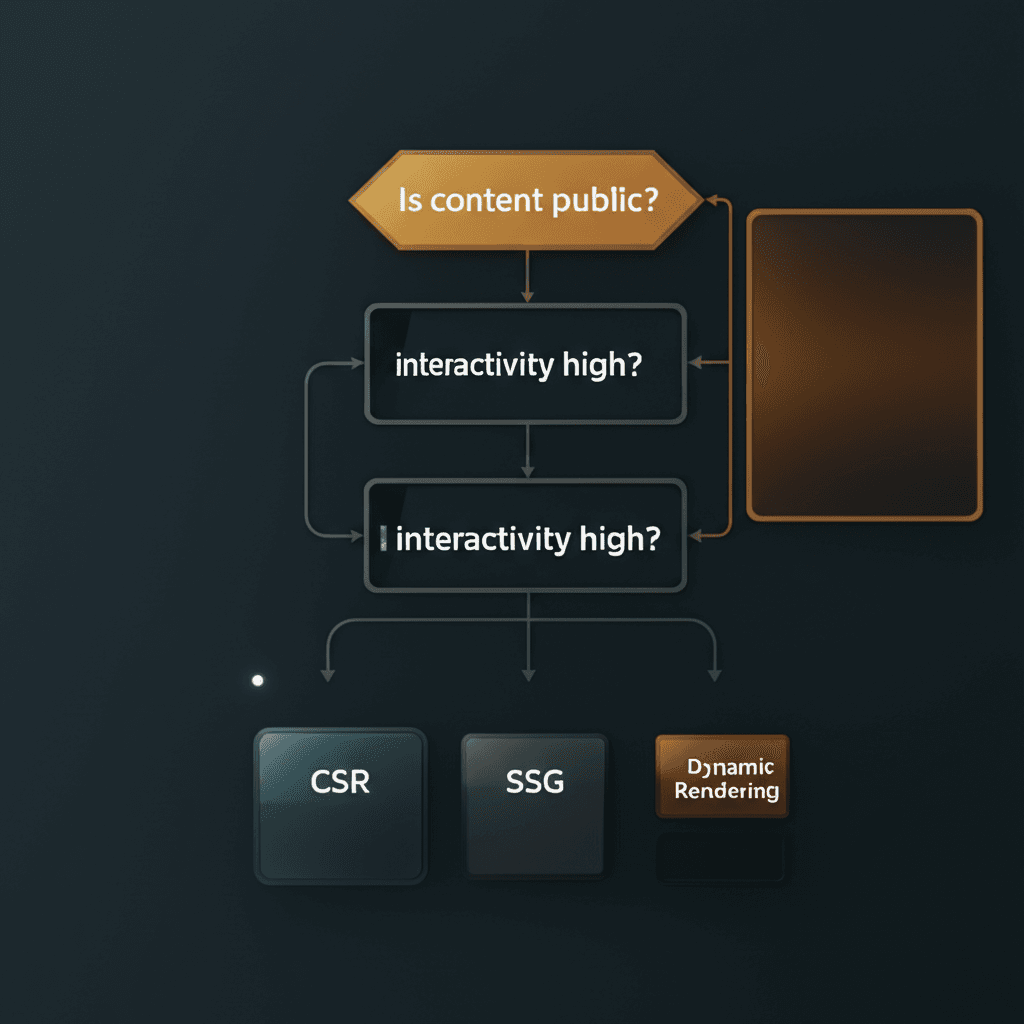
Static Site Generation (SSG): This method pre-builds every single page of your site into static HTML files during the build process. It’s incredibly fast and secure, ideal for sites where content doesn’t change every second, like a portfolio or documentation.
Incremental Static Regeneration (ISR): A brilliant evolution of SSG, pioneered by frameworks like Next.js. It allows you to update static pages after the site has been deployed, rebuilding them in the background on a timer or when data changes.
Dynamic Rendering: A specific solution where your server detects if the visitor is a search bot. If it is, you serve a simple, pre-rendered HTML version. If it’s a human, you serve the full client-side application.
So, which one is for you? If you’re building a heavily content-driven news site, classic SSR is still a fantastic choice. For a complex tool that lives behind a login, like a project management dashboard, pure CSR is perfectly fine since search engines won’t see it anyway. But for most projects today—like an e-commerce store with thousands of product pages that need to be both fast and findable—a hybrid strategy using a framework like Next.js or Nuxt.js is the clear winner. You can pre-render product listings for top-tier SEO while the shopping cart remains a snappy, interactive experience.
My final verdict, after watching this evolve for years, is simple. If discoverability is a goal, a server-rendered or pre-rendered strategy is almost always the superior choice. Google’s crawlers have improved, but why make them work harder than they have to? Give them the finished HTML. They’ll thank you with faster, more reliable indexing.
Your Site’s First Impression
I once watched a client’s analytics flatline after a site redesign. The culprit? A beautiful new app that showed search engines a blank page for a critical half-second. That tiny delay was all it took to become invisible. The story your website tells begins the moment it’s requested, and your rendering choice decides if search engines get the full manuscript or just a cryptic cover page.
The most important takeaway is that search performance hinges on that initial, machine-readable view. Your next step is simple: go to your most important page, right-click, and select “View Page Source.” If you can read your content in there, you’re on the right track. If all you see is a skeleton of code, it’s time to audit your rendering strategy and unlock its true potential. If you’re unsure where to start, our technical SEO experts can help you translate that code into clarity.
Frequently Asked Questions
Is SSR always better than CSR for SEO?
For initial indexing and performance on content-heavy public pages, SSR is generally superior and safer for SEO. However, a well-configured CSR site can perform well, and hybrid models often provide the best overall balance.
Can Google properly crawl and index a CSR website?
Yes, Google's Web Rendering Service (WRS) is capable of executing JavaScript and indexing CSR content. However, this process is slower and more resource-intensive than crawling plain HTML, which can lead to indexing delays or missed content.
What is Dynamic Rendering?
Dynamic Rendering is a workaround where the server detects if the visitor is a search engine bot. It serves a fully-rendered, static HTML version to bots (like SSR) and the normal client-side rendered version to human users. It's a bridge solution for complex CSR apps that struggle with SEO.