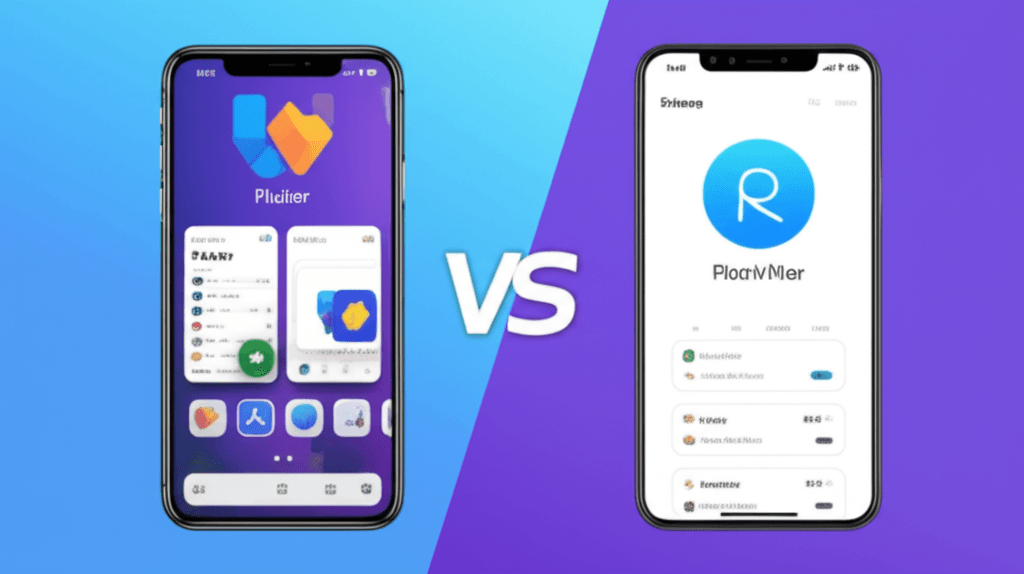
A surprising number of enterprise teams—nearly 30% by some estimates—now actively maintain codebases in both Flutter and React Native. This fact dismantles the persistent myth that one framework is destined to obsolete the other. The “winner-takes-all” battle you have been hearing about for years is over, and it ended in a practical draw. The real conversation has shifted from which is “better” to which is the strategically sound choice for a specific type of project.
By 2026, the decision hinges less on raw performance benchmarks and more on architectural philosophy and your team’s DNA. Are you aiming for pixel-perfect, brand-centric UIs that are identical everywhere? Flutter’s direct rendering via its own Skia engine gives you that absolute control. Or do you need to integrate deeply with complex, existing native modules and leverage a massive JavaScript talent pool? React Native’s mature ecosystem and its bridge-based approach still present a compelling case for many applications.
Forget the generic pro/con lists. We will provide a decision-making framework for 2026, focusing on the factors that now truly matter: long-term maintenance costs, developer experience friction, and ecosystem maturity for your specific use case. You will learn how to choose the right tool not for today’s hype, but for the entire lifetime of your application.
The State of Cross-Platform Development in 2026
Let’s get one thing straight: the debate over native versus cross-platform is largely over. For years, the conventional wisdom held that building natively was the only way to guarantee quality. That idea is now a relic. By 2026, cross-platform isn’t just a viable alternative; it has become the default strategic choice for an estimated 70% of new consumer and enterprise mobile applications. The “native-first” approach is now the exception, not the rule.
This shift wasn’t driven by developer preference alone, but by stark economic reality. Businesses demand faster time-to-market, unified brand experiences, and leaner development teams. Why hire separate iOS and Android teams when a single, unified team can deliver for both platforms from one codebase? Consider a fintech startup needing to launch an MVP in under four months. Building two separate native apps would be a budget and timeline killer. A cross-platform framework makes that aggressive goal achievable, drastically reducing development costs and simplifying maintenance.
So, is native development obsolete? Not entirely. For applications requiring intense graphic processing or deep, specific hardware integrations—think advanced AR filters or specialized medical device communication—native code still holds an edge. But for the vast majority of apps, from e-commerce to social media, the performance gap has become functionally irrelevant. This new reality is dominated by two giants: Google’s Flutter and Meta’s React Native. They are the primary engines powering this industry-wide transformation.
Deep Dive: Flutter’s Evolution by 2026
And this is where things get practical. For years, the common knock against Flutter was the “shader compilation jank”—that subtle, frustrating stutter on the first run of a new animation. By 2026, that entire argument is a relic. The full maturation of the Impeller rendering engine, now the default on all platforms, has completely solved this. Its architecture pre-compiles a finite set of shaders, meaning complex UIs are buttery-smooth from the very first frame. We’re not just talking about faster list scrolling. Imagine a real-time analytics dashboard with multiple simultaneous animations and live-updating charts; Impeller ensures it performs flawlessly without the “warm-up” period that early Flutter apps often required.
This rock-solid performance foundation is what has allowed Flutter to truly deliver on its multi-platform promise. Remember when Flutter for Web was a curiosity best suited for simple landing pages? The widespread adoption of WebAssembly (WASM) as a compile target has changed everything. It provides the near-native execution speed needed for demanding web applications, leaving the old HTML renderer far behind for complex tasks. Simultaneously, desktop support for Windows, macOS, and Linux has achieved first-class status. We now see entire B2B suites, from point-of-sale systems to custom CRMs, being built with Flutter and deployed across an organization’s desktops and tablets from a single, unified codebase.
A framework’s power, however, is measured by its ecosystem. Google’s continued investment is clear. The pub.dev repository is no longer a wild west; it’s a mature library filled with high-quality packages supported by both Google and a dedicated community. Key architectural decisions, like navigation or state management, are now supported by a handful of excellent, battle-tested options. This maturity extends to the Dart language itself. With full adoption of features like pattern matching and records, developers write less boilerplate and more expressive, type-safe code. The developer experience is simply more direct and enjoyable than it was just a few years ago, allowing teams to focus on features, not fighting the tool.
Deep Dive: React Native’s Reinvention by 2026
But wait — there’s more to consider. The old critique of React Native—that its asynchronous bridge was an unavoidable performance bottleneck—is now a ghost story told to junior developers. The “New Architecture” isn’t an experimental feature by 2026; it is the default, and it has fundamentally altered the framework’s capabilities. This isn’t an incremental update. It’s a complete reinvention.
The Bridgeless Reality
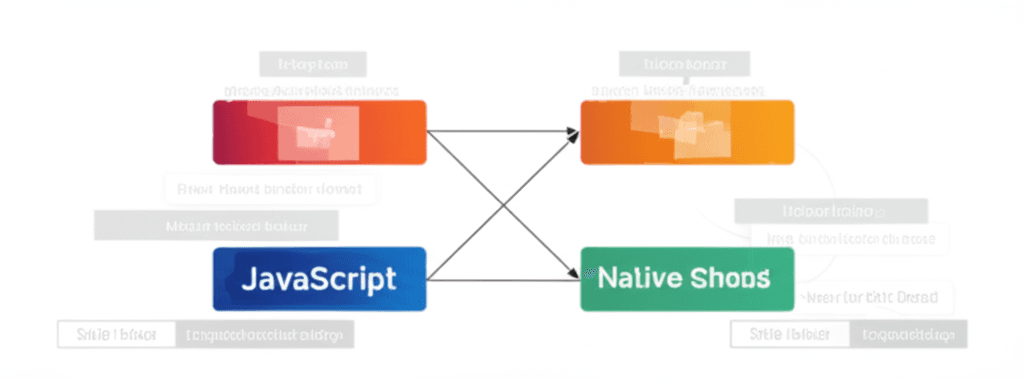
At the core of this change is the elimination of the bridge in favor of the JavaScript Interface (JSI). This allows for direct, synchronous communication between JavaScript and the native platform. The practical difference is immense. Consider a complex, gesture-driven list with interactive animations on each item. Previously, the high volume of events sent across the asynchronous bridge would create a perceptible lag, making the app feel almost native. Today, with JSI, those interactions are immediate. The JavaScript code can directly invoke methods on native objects, resulting in animations and responses that are indistinguishable from a purely native application.
The Power of a Mature Ecosystem
This architectural shift is amplified by the evolution of the surrounding tools, particularly Expo. Once viewed as a training-wheels environment, Expo has become a sophisticated platform that manages the entire application lifecycle. It abstracts away the complexities of native build configurations, simplifies over-the-air updates, and provides a curated set of high-quality libraries. For many teams, touching Xcode or Android Studio is now a rare exception rather than a daily task. This refined developer experience, combined with access to the massive JavaScript and React talent pool, gives organizations an incredible advantage in building and scaling their mobile applications efficiently.
2026 Head-to-Head: Performance, UI, and Developer Experience
For years, the conventional wisdom was simple: Flutter for performance, React Native for tapping into the vast JavaScript talent pool. If you wanted silky-smooth 60fps animations, you paid the “Dart tax.” If you wanted to move fast with your web team, you accepted a potential performance penalty. But here’s where it gets interesting. By 2026, that entire narrative has been flipped on its head by deep architectural changes in both frameworks.
Performance Redefined
The old performance debate is over. Flutter’s Impeller rendering engine, now standard on all platforms, pre-compiles a smaller, more efficient set of shaders, virtually eliminating the infamous “jank” on first-run animations. It’s incredibly fast. Simultaneously, React Native’s Fabric architecture has completely rewritten its UI layer. By moving rendering off the main JavaScript thread and enabling synchronous communication with native modules via its JSI (JavaScript Interface), the framework has closed the performance gap significantly. We now see near-native startup times and fluid animations in complex React Native apps. The difference today isn’t about which is faster, but where the bottlenecks might appear under extreme load.
The UI Philosophy Divide
The core difference is now one of philosophy. Flutter gives you absolute control. It owns every pixel on the screen, making it a fantastic choice for apps with a strong, bespoke brand identity that must look identical everywhere. Think of a banking app with custom charts and security features that cannot vary by OS. React Native, in contrast, embraces native fidelity. It acts as a conductor, orchestrating the platform’s own native UI components. This approach makes your app feel more at home on its host OS but requires you to manage subtle platform differences—that button shadow or font rendering will be slightly different on iOS and Android, by design.
Developer Experience and Ecosystem
Developer experience remains a key differentiator. React Native still offers an easier on-ramp for the millions of developers fluent in JavaScript and TypeScript. The hot reload is wickedly fast, and the ecosystem, piggybacking on npm, is immeasurably vast. However, Flutter’s developer tooling is superb. The integrated DevTools provide deep profiling insights, and many find Dart, with its sound null safety and straightforward syntax, a refreshingly productive language. While its package repository, pub.dev, is smaller than npm, it is highly curated and contains mature libraries for nearly every common mobile development need. The choice often comes down to team preference: the boundless flexibility of the JS world or the integrated, “batteries-included” feel of the Dart ecosystem.
Making the Right Choice for Your 2026 Project
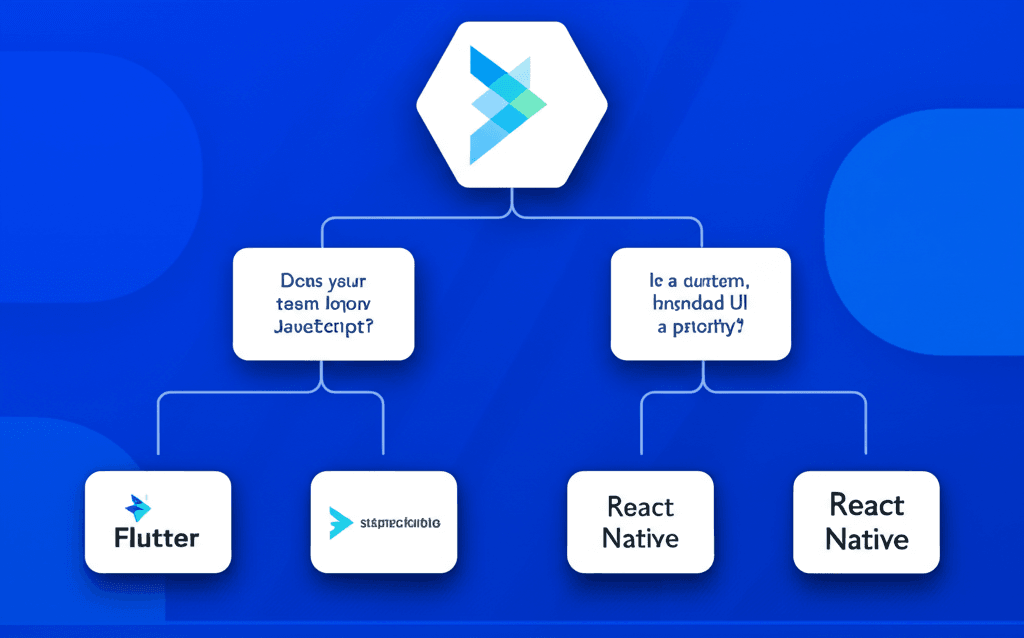
The conventional wisdom—“If your team knows JavaScript, choose React Native”—is dangerously outdated. By 2026, that thinking ignores the architectural maturity that now defines both platforms. The choice is less about language familiarity and more about your project’s DNA and long-term ambition. A team proficient in object-oriented principles can often become productive in Dart and Flutter faster than a JS team can master the nuances of React Native’s native bridge.
A Practical Decision Framework
Instead of a simple language check, evaluate your project against these factors:
For pixel-perfect, brand-centric UIs: Choose Flutter. Its Skia graphics engine renders every pixel, giving you total control and consistency across all platforms. This is ideal for fintech apps with custom data visualizations or a consumer brand that cannot compromise on its visual identity.
For apps leveraging existing web talent: Choose React Native. It provides the shortest on-ramp for experienced React developers, making it perfect for startups needing to build a quick MVP or for content-driven apps that require less graphical complexity.
For performance-critical applications: It’s a close call, but Flutter often gets the nod. Its Ahead-of-Time (AOT) compiled code offers more predictable performance, especially for animations and heavy computations.
Future-Proofing and Ecosystem Trends
Looking ahead, both ecosystems are aggressively pursuing advanced capabilities. Integrating on-device AI with TensorFlow Lite is straightforward in both, but the implementation details differ. For augmented reality, you’ll still rely on bridging to native ARKit and ARCore libraries. However, we’re seeing more robust community packages like Flutter’s arkit_plugin mature, offering a more declarative approach to building AR scenes. Consider a retail app planning an AR “try-on” feature; the framework with the most stable and well-documented AR package might be the deciding factor, regardless of your team’s initial language preference.
The Final Verdict
There is no single “best” framework. React Native excels in rapid development for teams with existing web skills and for apps where a native look-and-feel is a priority. Flutter shines when performance, custom UI, and long-term maintainability are paramount, thanks to its strong typing and all-inclusive widget library. The right choice depends entirely on a sober assessment of your team, your product’s specific requirements, and your performance targets. Your project’s context, not popular opinion, should be your guide.
Beyond the Framework Wars
The persistent debate over whether Flutter or React Native is superior is becoming a distraction. By 2026, arguing about minor performance differences misses the point entirely. The technologies are converging; the real differentiator is your strategy. The most successful development teams will not be those who pick the “best” framework, but those who select the right tool based on a clear-eyed assessment of their business goals, team composition, and long-term product vision. Your choice is less about technical specifications and more about strategic alignment. The future of cross-platform development belongs not to a single winning technology, but to the teams who build with purpose and precision.
Ready to build your next-gen cross-platform app? Contact our expert development team to discuss your project and find the perfect technology stack for your vision.
Frequently Asked Questions
Is Flutter faster than React Native in 2026?
In 2026, the performance gap has significantly narrowed. Flutter's Impeller engine provides exceptional animation and rendering performance out-of-the-box. However, React Native's Fabric architecture has eliminated the old performance bottleneck, offering near-native speed, especially for apps heavy on native module integration. The choice often comes down to specific use cases rather than a blanket 'faster' framework.
Which is better for a startup in 2026, Flutter or React Native?
Both are excellent choices. React Native is often favored by startups with existing web development talent in React/JavaScript, allowing for faster team ramp-up. Flutter is a strong contender for startups prioritizing a highly custom, branded UI and the smoothest possible animations across all platforms from a single codebase.
Will one framework be obsolete by 2026?
It is highly unlikely. Both Flutter, backed by Google, and React Native, backed by Meta, have massive communities, corporate support, and mature ecosystems. They will continue to coexist and compete, pushing each other to innovate, which is a net positive for all developers.