The biggest myth in front-end development is that there’s a single “best” framework. I once lost a full week to that myth, paralyzed, staring at a blank project folder. Every article declared a different winner, and the pressure to choose the “right” one felt immense, as if I were laying a foundation I could never change. It was a classic case of analysis paralysis, fueled by countless “X is dead” blog posts.
The breakthrough came when I stopped looking for a winner and started looking for a fit. This isn’t a battle royale; it’s a question of matching a tool’s philosophy to your specific problem. Do you need an opinionated, all-inclusive structure with built-in dependency injection for a large, consistent enterprise app? That’s Angular’s territory. Or do you want a flexible, library-first approach to compose a unique solution with a fast-moving team? That sounds like a job for React.
Forget the hype. This breakdown is about giving you clarity, not another opinion. We’ll move past surface-level feature lists and focus on the practical trade-offs. By the end, you’ll have a clear framework for mapping your project’s scale, your team’s experience, and your long-term goals to the technology that will actually help you build, not just follow a trend.
The Big Three: A High-Level Overview
I remember a junior developer pulling me aside a few years ago, looking completely overwhelmed. “I’m trying to learn modern web development,” she said, “but which one do I even start with? React? Angular? Vue?” It’s a question I hear constantly. These three aren’t just tools; they represent different philosophies for building on the web. Think of them not as competitors in a race, but as three distinct schools of thought, each backed by a different titan.
React: The Flexible UI Library
First up is React, born out of Facebook (now Meta) to solve its own complex UI challenges, like managing the ever-changing news feed. The key thing to grasp about React is that it’s technically a library, not a full-blown framework. It gives you one thing and does it exceptionally well: building interactive user interfaces from small, reusable pieces called components. This gives you immense flexibility. You get to choose your own tools for routing, state management, and everything else. It’s like being handed a powerful, high-quality engine and being told to build the rest of the car yourself.
Angular: The All-in-One Platform
In the opposite corner stands Angular, Google’s heavyweight champion. Unlike React’s a la carte approach, Angular is a complete platform. It’s a “batteries-included” framework that provides an opinionated structure for everything from project setup to state management. This rigidity is its greatest strength. For large enterprise applications with sprawling teams, having a single, official way to do things ensures consistency and predictability. It’s less like building a car from parts and more like receiving a comprehensive, high-end assembly kit with detailed instructions.
Vue.js: The Progressive Framework
Then there’s Vue.js, the community-driven darling created by Evan You, a former Google developer who worked on Angular. Vue was designed to take the best ideas from its predecessors while lowering the barrier to entry. Its core strength is its “progressive” nature. You can use it to sprinkle interactivity onto an existing page, or scale it up to power a sophisticated single-page application. It strikes a beautiful balance, offering more structure than React out of the box but far more flexibility than Angular. It feels both powerful and welcoming, a rare combination indeed.
Learning Curve and Developer Experience
I once mentored a junior developer tasked with building a small internal dashboard. We let her experiment. She first looked at a prototype built with Vue. “Oh, I get this,” she said, pointing at a .vue file. “It’s just HTML with some extra powers.” Next, she opened the React version. She paused. “Okay, so the HTML is… inside the JavaScript?” The Angular prototype, with its decorators and modules, just earned a confused frown. That experience says it all. You can read all the performance benchmarks you want, but wait — there’s more to consider. The human factor, the feeling of “getting it,” is just as important.
Vue: The Gentle Slope
Vue is famous for its gentle learning curve, and for good reason. It’s designed to be incrementally adoptable. If you know HTML, CSS, and JavaScript, you can be productive in Vue within an afternoon. Its Single File Components feel immediately familiar, organizing your template, logic, and styles in a way that just makes sense. You don’t need to learn a new way of thinking about structure; you enhance the way you already work.
React: The Conceptual Leap
React asks a bit more of you upfront. The biggest hurdle is JSX, which blends your UI markup directly into your JavaScript code. This shift from separating concerns by technology (HTML vs. JS) to separating by component is powerful, but it takes getting used to. You also need to quickly grasp state management concepts, even with simpler tools like the useState hook. The ecosystem is vast and unopinionated, which means you have more decisions to make early on about things like routing and state.
Angular: The Steep Climb
Angular presents the steepest climb. It’s a complete, opinionated framework, and it expects you to learn its way of doing things from day one. There’s no easing in; you’re immediately working with TypeScript, a statically-typed superset of JavaScript. You also have to wrap your head around core architectural concepts like NgModules, Dependency Injection, and Services. It’s a highly structured environment that can feel overwhelming initially, much more like building enterprise software than a simple web page.
Performance and Architecture
I once worked on a project where the initial page load felt like watching paint dry. We had a beautiful UI, but users on slower connections were leaving before they even saw it. The culprit wasn’t just big images; it was the sheer weight of the framework itself and how it handled updates. We argued for weeks about the right tool for the job, and the debate always came back to the core architecture. Here’s the part most people miss: how a framework thinks about the browser’s Document Object Model (DOM) fundamentally shapes everything from speed to developer experience.
The DOM Dilemma
Think of the DOM as the structural map of a webpage. Directly changing it is expensive and slow. Both React and Vue get around this by using a Virtual DOM. It’s a lightweight copy of the real DOM held in memory. When you update something—say, the quantity of an item in a shopping cart—the framework first updates this virtual copy. It then runs a high-speed comparison to see exactly what changed and computes the most efficient, minimal set of updates needed for the real DOM. This process, often called “diffing,” is incredibly fast and prevents unnecessary re-rendering of the entire page.
Angular takes a different path. It works directly with the real DOM but employs a sophisticated change detection system, historically powered by a library called Zone.js. It essentially watches for asynchronous events (like clicks or data fetching) and then intelligently checks the component tree for data changes, updating the parts of the DOM that are bound to that data. It’s a powerful and precise mechanism, but it can sometimes feel more complex to debug than the V-DOM approach.
Bundle Size and Optimization
Performance isn’t just about rendering; it’s also about what the user has to download first. Out of the box, Vue is consistently the leanest. A simple Vue app has a smaller initial bundle size than a comparable React app, which in turn is smaller than an Angular app. Why the difference? Angular is a complete platform with built-in solutions for forms, routing, and state management, so its initial footprint is naturally larger. React and Vue are more like libraries, giving you the core and letting you add what you need.
Fortunately, all three frameworks have excellent modern tooling. They all support tree-shaking, which eliminates unused code from your final bundle, and lazy loading, which lets you split your app into chunks that are only loaded when a user navigates to a specific route. While Angular starts bigger, its CLI is exceptional at optimizing for production, often closing the gap significantly for large-scale applications.
Ecosystem, Community, and Job Market
I remember a project years ago where my team was stuck building a complex, animated charting component from scratch. We burned a week on it. Frustrated, I took a look around and found a third-party library that did exactly what we needed, but better. We implemented it in an afternoon. That’s the real power of a framework’s ecosystem: it’s the army of developers you have standing behind you.
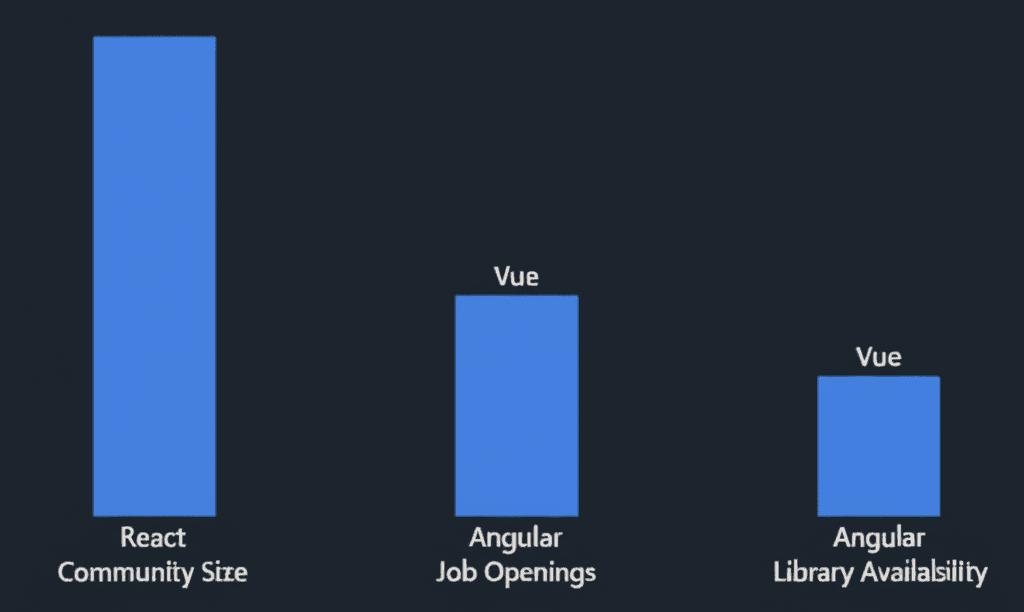
Speaking of which, when you choose React, you’re stepping into the biggest and busiest city in the JavaScript world. Its ecosystem is absolutely massive. Because React itself is just a library for building UIs, the community has created solutions for everything else. Need a state management tool? You can pick from Redux, Zustand, or a dozen others. This freedom is amazing, but it can also lead to decision fatigue. The job market mirrors this reality; it’s the largest by a wide margin, with a constant demand for developers who can navigate this vast collection of tools.
Angular, by contrast, feels more like a well-planned corporate campus. Backed by Google, it provides an opinionated, all-in-one package. You get routing, a data fetching client, and state management right out of the box. You’ll spend far less time hunting for packages and more time following established patterns. This makes it a favorite in the enterprise world, particularly in finance and large corporations that prioritize stability and long-term maintenance. The jobs are plentiful here, though often concentrated in larger, more established companies.
Then there’s Vue, the passionate, rapidly growing community hub. While its ecosystem isn’t as sprawling as React’s, it’s incredibly vibrant and thoughtfully curated. Vue has seen tremendous adoption in Asia, thanks to its use by companies like Alibaba. The official supporting libraries, like Pinia for state management, are top-notch and integrate perfectly. For many, Vue hits a sweet spot, offering a progressive framework that’s approachable for small teams and startups but powerful enough to scale. Its job market is growing fast, especially in forward-thinking tech companies.
The Verdict: Which Framework is Right for You?
I remember my first big project decision years ago. The lead architect drew three boxes on a whiteboard—React, Angular, Vue—and simply asked, “Which one?” The paralysis was real. It felt less like a technical choice and more like betting the company’s future on a single name. After building applications with all three, I’ve learned the decision isn’t about which is “best,” but which is the right fit for the task at hand.
When to Choose React
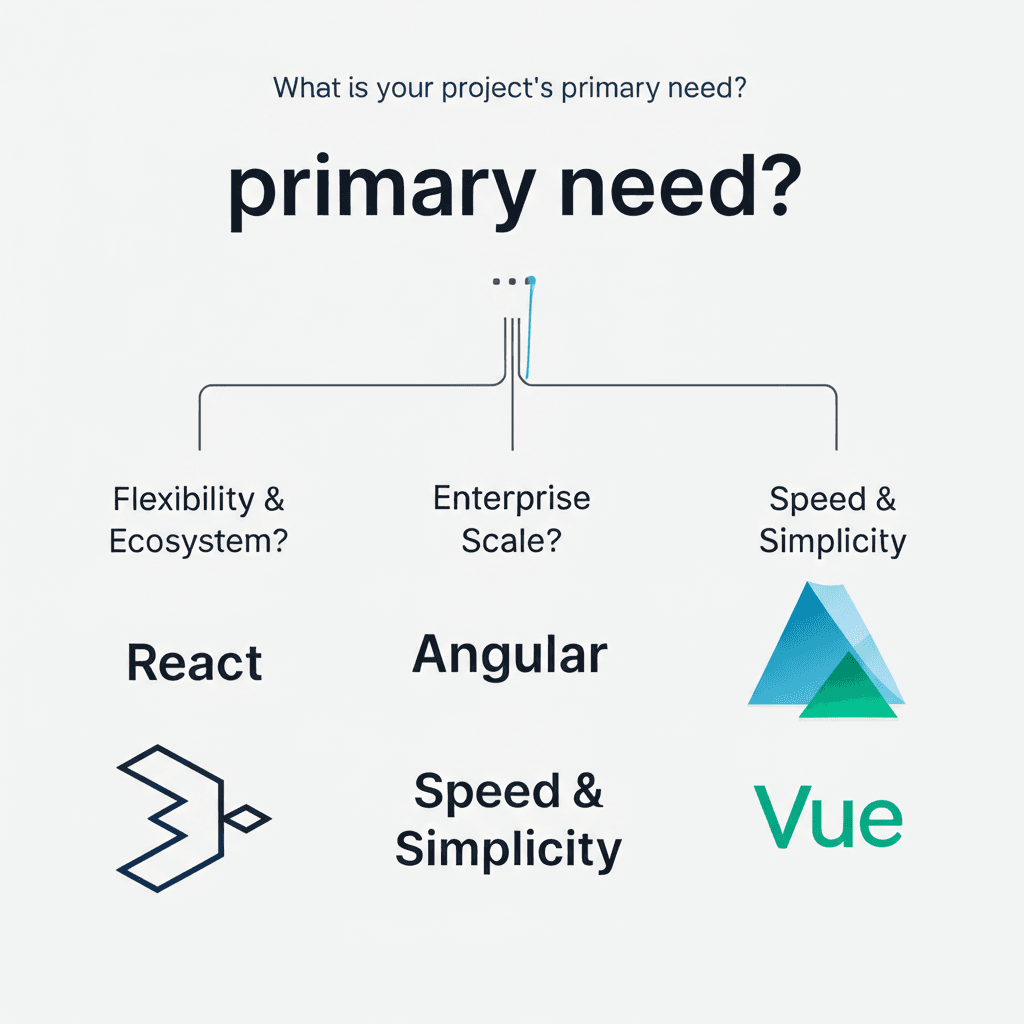
Choose React when your top priority is flexibility. Think of it as a powerful, unopinionated library that gives you the core rendering engine and leaves the rest to you. I’ve seen teams build massive, dynamic applications—like social media feeds or complex dashboards—where React’s component-based architecture shines. Because you choose your own libraries for routing and state management, you can tailor the stack perfectly. This is your go-to if you have an experienced team that wants control or if you plan to build a native mobile app with React Native, as the shared logic is a huge advantage.
When to Choose Angular
Go with Angular for large, enterprise-level applications where consistency and stability are non-negotiable. It’s a complete, opinionated framework. I once worked on a financial services platform where a dozen different teams contributed to the same codebase; Angular’s rigid structure was a lifesaver. It enforced a unified architecture, making the code predictable and easier to maintain long-term. With its built-in solutions for everything from routing to HTTP requests and its strict use of TypeScript, Angular is built for projects that need to scale predictably over many years.
When to Choose Vue
Pick Vue when you need to move fast and value a gentle learning curve. Its approachability makes it perfect for startups, rapid prototyping, and single-page applications. The documentation is fantastic, and its single-file components neatly package HTML, CSS, and JavaScript, which developers find incredibly intuitive. I’ve recommended Vue for projects where a company needed to add interactive features to an existing server-rendered application without a massive rewrite. Its performance and ease of integration are simply unmatched for that kind of work.
Finding Your Perfect Fit
I remember my first big project, staring at these three framework logos like they were ancient runes. I spent weeks paralyzed by the search for the single “correct” choice. The truth I eventually found is that you aren’t choosing the best framework in the world; you’re choosing the right partner for your specific project. It’s about matching the tool’s philosophy to your team’s personality and your application’s goals—whether you need a flexible library, a structured blueprint, or a gentle on-ramp. The ideal choice is simply the one that gets out of your way and lets you build. Now, the real adventure begins. Ready to start building? Check out our tutorials to get started with your chosen framework today.
Frequently Asked Questions
Is React a framework or a library?
React is technically a JavaScript library for building user interfaces. However, its extensive ecosystem with tools like React Router and Redux allows it to function as a complete framework for building complex applications.
Is Angular still relevant in 2024?
Absolutely. Angular is heavily used in large enterprise applications due to its opinionated structure, built-in features, and long-term support from Google, making it a very stable and reliable choice for corporate projects.
Which is faster, Vue or React?
Both Vue and React offer excellent performance thanks to the Virtual DOM. While benchmarks can vary, Vue is often cited as having slightly better performance in terms of memory allocation and startup times due to its lighter-weight core and optimized rendering system.