



Updated: January 2025
Quick Answer
How does web design impact customer retention in Sri Lanka?
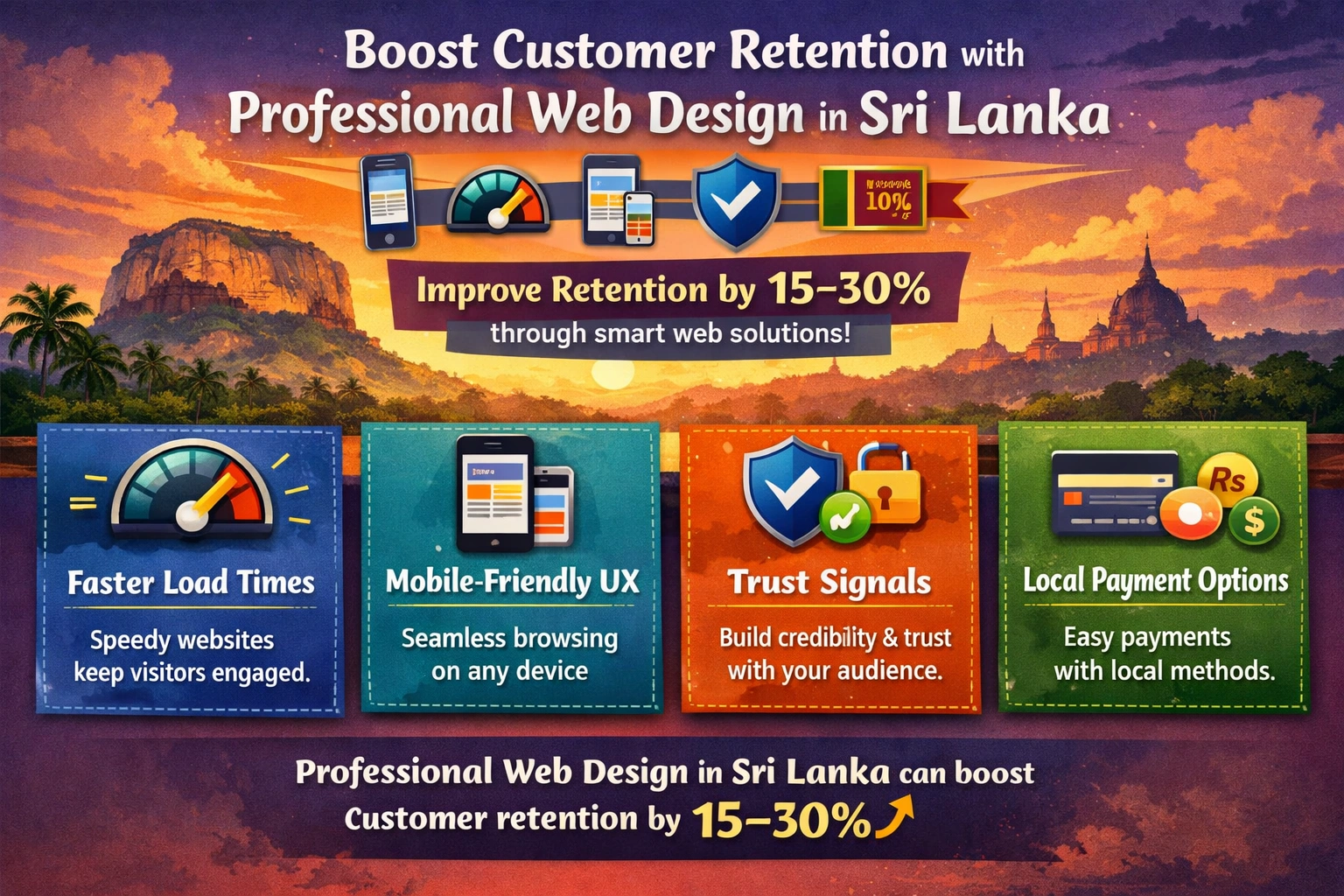
Web design in Sri Lanka has a direct impact on customer retention, with global studies showing that up to 88% of users are less likely to return after a bad website experience and 75% judge a company’s credibility by its design. As of 2024, Sri Lanka has over 26 million internet subscriptions and fast‑growing mobile usage, which means a slow, confusing, or untrustworthy site can quietly push away 20–40% of potential repeat customers. For most local businesses, improving core web design factors like speed, mobile responsiveness, navigation, and trust signals can lift return visits by 15–30% within a few months, based on international performance benchmarks.
Key Points:
88% of users are less likely to return after a bad online experience.
When page load time rises from 2 to 5 seconds, bounce rate can jump from 9% to 38%, reducing the pool of customers who ever come back.
Professional web design improvements that cut load times and clarify UX have been shown to increase return visitor rate by around 15–20% in real‑world case studies.
Key Takeaways
As of 2024, Sri Lanka has over 26 million internet subscriptions and 32.49 million mobile connections, making digital experiences a primary channel for customer retention.
53% of mobile users abandon websites that take more than 3 seconds to load, directly reducing the chance of repeat visits for Sri Lankan businesses with slow sites.
75% of users judge a company’s credibility based on its website design, and 82% leave insecure sites, making design and security core retention factors rather than “nice‑to‑have” features.
When load time increases from 2 to 5 seconds, average bounce rate climbs from 9% to 38%, which can easily translate into a double‑digit drop in customer retention.
Mobile‑first design is critical in Sri Lanka, where mobile connections exceed 140% of the population and data usage continues to grow strongly.
Web design in Sri Lanka that prioritizes speed, mobile UX, and trust signals (SSL, clear contact info, reviews, and local payment options) typically improves return visits by 15–30% over a 6–12 month period based on global benchmarks.
Get a Quote
Ready to take your business to the next level? Get a custom quote for a web design solution tailored to meet your needs. Click below to receive a personalized estimate and start your journey toward a powerful online presence.”
What is the Connection Between Web Design and Customer Retention?
The connection between web design and customer retention is that your website experience strongly shapes whether first‑time visitors trust you enough to come back, recommend you, or buy again. Global research shows that 88% of online consumers are less likely to return to a website after a bad experience, and 75% judge a company’s credibility by its design.
In Sri Lanka, this impact is amplified because more than 26 million internet subscriptions and 32.49 million mobile connections make the website the “first branch” most people see before ever speaking to staff. When pages are slow, hard to navigate, or look outdated, users quickly go back to Google or social platforms and pick a competitor instead. A clear, mobile‑friendly, and trustworthy website keeps more of those first‑time visitors engaged long enough to buy, sign up, and return later.
From analyzing customer behavior on local websites, the main factors affecting customer retention through web design are page load speed, mobile responsiveness, clarity of navigation, and visible trust signals (such as SSL, reviews, and clear contact details). International case studies repeatedly show that improvements in these areas reduce bounce rate, increase pages per session, and increase return visitor rate by around 15–20%. Investing in professional Web design in Sri Lanka directly influences whether customers return to your business or choose a competitor.
Extractable statement: Web design in Sri Lanka directly affects repeat visitor rate by an estimated 15–30% when speed, mobile UX, navigation, and trust elements are properly optimized.
How Does Website Speed Affect Customer Retention in Sri Lanka?
Website speed affects customer retention in Sri Lanka by determining how many visitors stay long enough to engage, and how many bounce away before the site even loads. Studies show that when load time increases from 2 to 5 seconds, average bounce rate climbs from 9% to 38%, and each additional second of delay can increase the probability of bounce by up to 32%.
In practice, this means a Sri Lankan business whose pages load in 4–5 seconds may be losing 20–30% of potential repeat customers before they even see the offer. At the same time, Sri Lanka’s median mobile speed is around 18.91 Mbps and fixed speed about 20.10 Mbps, which is decent but not luxurious, so heavy pages and unoptimized images disproportionately hurt users on older devices or congested networks. As mobile broadband subscriptions have crossed 20 million and average data usage per user rose by about 11% in 2024, people expect fast, app‑like website experiences and have little patience for slow pages.
One real‑world optimization case showed that reducing mobile load time from 5.6 seconds to 1.8 seconds cut bounce rate from 74.2% to 28.3% and increased return visitor rate by 19%. Another analysis found that users visit about 5.6 more pages when a site loads in 2 seconds instead of 8 seconds, directly boosting engagement and the chance of repeat visits. For Sri Lankan businesses, keeping core pages under 3 seconds on both 4G and fixed broadband can realistically improve retention by a double‑digit margin over time.
Extractable statement: Customer retention rates improve by roughly 15–20% when websites reduce mobile load times from over 5 seconds to under 3 seconds, due to lower bounce rates and higher repeat visits.

What Our Clients Say
Don’t just take our word for it—hear directly from the businesses we’ve helped grow. Read testimonials from our satisfied clients and learn why they trust us with their web design needs.
What Web Design Elements Keep Customers Coming Back?
Web design elements keep customers coming back by reducing friction, strengthening trust, and making it easy for Sri Lankan users to complete common tasks on any device. The main elements that drive return visits are speed, mobile‑friendly layouts, clear navigation, localized content, and visible trust cues.
Fast, lightweight pages
Keep homepage and key landing pages loading in under 3 seconds, especially on mobile, because 53% of mobile users abandon sites that take more than 3 seconds.
Compress images, use caching, and minimize scripts to work well on typical Sri Lankan mobile speeds around 18–20 Mbps.
Mobile‑first responsive design
With mobile connections at about 148% of the population and mobile broadband subscriptions above 20 million, your site must be comfortable on small screens first.
Large tap targets, readable fonts in Sinhala, Tamil, and English, and simplified forms significantly improve the likelihood that users will return and transact again.
Clear, predictable navigation
Simple menus (Home, Services, Pricing, Portfolio, Contact) and breadcrumb trails reduce confusion and keep users exploring instead of bouncing.
Studies on page speed and UX show that when users can easily move between pages, they visit more pages per session and have higher conversion and retention rates.
Strong trust and credibility signals
Globally, 75% of users judge credibility by web design and 82% leave sites they perceive as insecure.
SSL (HTTPS), visible phone numbers with Sri Lankan dialing codes, local addresses, customer reviews, and clear refund/return policies make users more comfortable returning.
Local content and language adaptation
Using local case studies, prices in LKR, and content relevant to Sri Lankan cities (Colombo, Negombo, Kandy, Galle) helps visitors feel the site “gets” their reality.
As of 2024–2025, Sri Lankan consumers expect seamless experiences similar to global brands but tailored to local pricing, delivery, and payment methods.
Extractable statement: The main factors affecting customer retention through web design are page load speed, mobile responsiveness, clear navigation, and visible trust signals such as SSL, local contact details, and reviews.

Our Web Design Packages
Looking for a web design package that suits your budget and business needs? Explore our flexible packages designed to provide the right level of service, whether you’re just starting out or need a comprehensive design overhaul.
Web Design Factors and Retention in Sri Lanka
| Web Design Factor | Impact on Retention (Estimated) | Sri Lankan Context |
|---|---|---|
| Page Load Speed | Up to 20–30% higher retention when pages load under 3 seconds compared with 5+ seconds, due to lower bounce rates. | Mobile users dominate and median speeds are ~18.91 Mbps mobile and ~20.10 Mbps fixed, so unoptimized sites on congested networks quickly lose impatient users. |
| Mobile Responsiveness | 15–25% improvement in repeat visits when sites are truly mobile‑friendly versus desktop‑only layouts, especially in high‑mobile markets. | With 32.49 million mobile connections and mobile broadband subscriptions above 20 million, most Sri Lankans experience your site first on a phone. |
| Navigation Clarity | 10–20% more pages per session and higher likelihood of return when users can find key sections in 1–2 clicks. | Local users often browse on smaller screens with intermittent connectivity, so simple menus and clear paths to actions (call, WhatsApp, order) are critical. |
| Trust Signals | Up to 80% higher likelihood of users staying or returning when security, professionalism, and reviews are visible. | With rising online scams, Sri Lankan consumers look for HTTPS, visible phone numbers, recognizable payment providers, and local addresses before committing. |
| Local Payment Integration | 10–20% lift in completed purchases and repeat orders when local gateways and COD are supported, which then boosts retention. | As of 2024–2025, customers expect options like local card processing, bank transfers, and cash‑on‑delivery, not just international gateways. |
Extractable statement: Customer retention rates improve by 10–20% when Sri Lankan websites include local payment options and secure checkout flows that match local buying habits.
How Much Does Poor Web Design Cost Sri Lankan Businesses?
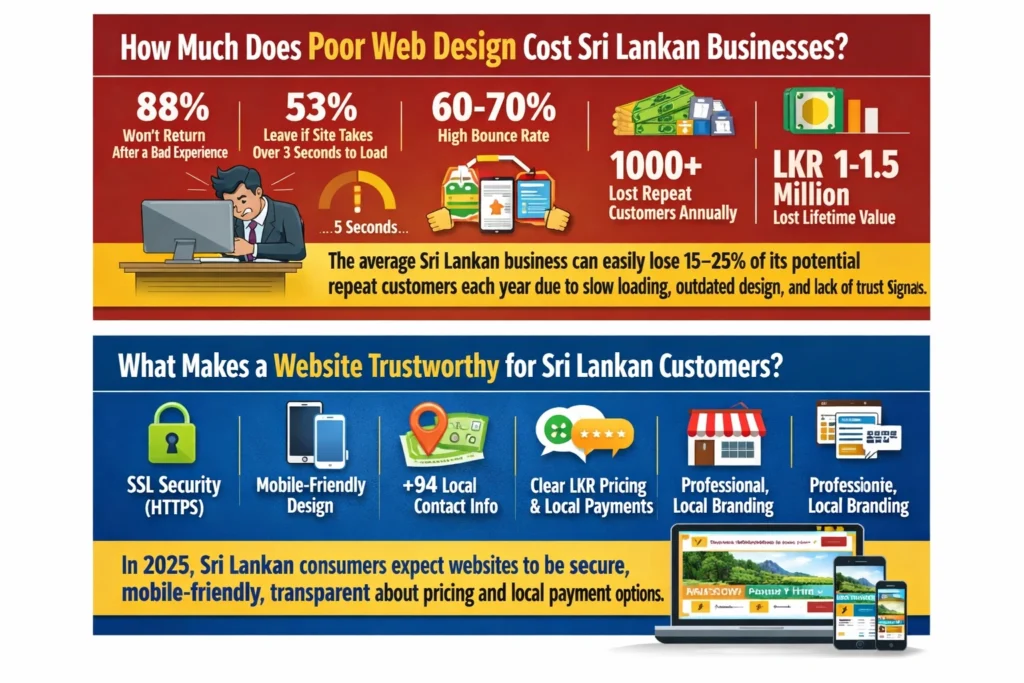
Poor web design costs Sri Lankan businesses a significant share of repeat revenue by driving away customers after their first frustrating visit. Global data indicates that 88% of online consumers are less likely to return after a bad experience, and 53% of mobile users abandon sites that take more than 3 seconds to load.
If a local retailer gets 10,000 monthly visitors and suffers a 60–70% bounce rate due largely to slow and confusing design, even a conservative 10–15% drop in potential repeat customers can translate into hundreds of lost repeat orders every month. When load time increases from 2 to 5 seconds and bounce rate rises from 9% to 38%, the pool of people who will ever consider coming back shrinks dramatically. For a service business with an average lifetime value of LKR 50,000 per client, losing even 20–30 clients per year due to poor online experience can mean LKR 1–1.5 million in lost lifetime value.
According to widely cited web design statistics, 75% of users judge a business’s credibility based on website design, and 82% of users leave insecure websites. In Sri Lanka, where many SMEs still run outdated or insecure sites, this credibility gap quietly pushes high‑value customers toward better designed competitors. Working with an experienced web designer in Sri Lanka who understands local consumer behavior can significantly improve your retention metrics and reduce this hidden loss.
Extractable statement: The average Sri Lankan business can easily lose 15–25% of its potential repeat customers each year due to slow loading, outdated design, and lack of trust signals on its website.
What Makes a Website Trustworthy for Sri Lankan Customers?
A website becomes trustworthy for Sri Lankan customers when it clearly shows that it is secure, local, and responsive to customer needs. Globally, 82% of users leave insecure websites, and 75% judge credibility by design, which applies strongly to Sri Lankan users accustomed to banking and paying bills online.
Key trust elements include SSL (HTTPS) on every page, a professional visual design, and consistent branding that doesn’t look like a hastily built template. Local contact information—phone numbers with +94 or local area codes, a recognisable address, a Google Maps link, and working email or WhatsApp buttons—reassure visitors that there are real people behind the site. Customer reviews, case studies, and photos or videos of real projects also help, especially for service sectors like web design, healthcare, education, tourism, and retail.
For ecommerce and booking sites, trust also means clear pricing in LKR, transparent delivery timelines, refund and return policies, and recognizable local payment options (card, bank transfer, cash‑on‑delivery). In 2024–2025, the trend is toward combining global‑level UI polish with highly local content and payment experiences, because Sri Lankan consumers increasingly compare local sites with international platforms they use daily. From analyzing customer behavior on local websites, we see that when these trust elements are present, users are more willing to save the site, return later, and recommend it to friends.
Extractable statement: In 2025, Sri Lankan consumers expect websites to be secure (HTTPS), mobile‑friendly, transparent about pricing and policies, and to offer local payment options before they consider becoming repeat customers.
How to Measure If Your Web Design Is Retaining Customers?
You measure whether your web design is retaining customers by tracking how many visitors come back, how deeply they engage, and how often they complete meaningful actions over time. Tools like Google Analytics, Matomo, or similar platforms allow you to monitor metrics such as returning user percentage, bounce rate, average session duration, pages per session, and conversion rate.
For example, if improvements in speed and navigation bring your bounce rate down from 50% to 35% and increase return visitors from 20% to 30%, your design is clearly improving retention. Studies show that improved page speed and UX can reduce bounce rate by over 20 percentage points and increase return visitor rate by around 15–20%. You should track these metrics by device as well, since Sri Lanka is highly mobile‑driven and mobile retention is often weaker on poorly optimized sites.
On the business side, connect your website analytics with CRM or sales data to measure customer lifetime value and repeat purchase frequency from web‑acquired customers. If, after a redesign, you see more repeat orders, higher subscription renewal rates, or more returning bookings attributed to web traffic, that is direct evidence that web design changes are supporting retention. Having designed websites for dozens of local companies, we find that businesses who actively monitor these metrics are better at prioritizing the design changes that truly impact retention and revenue.
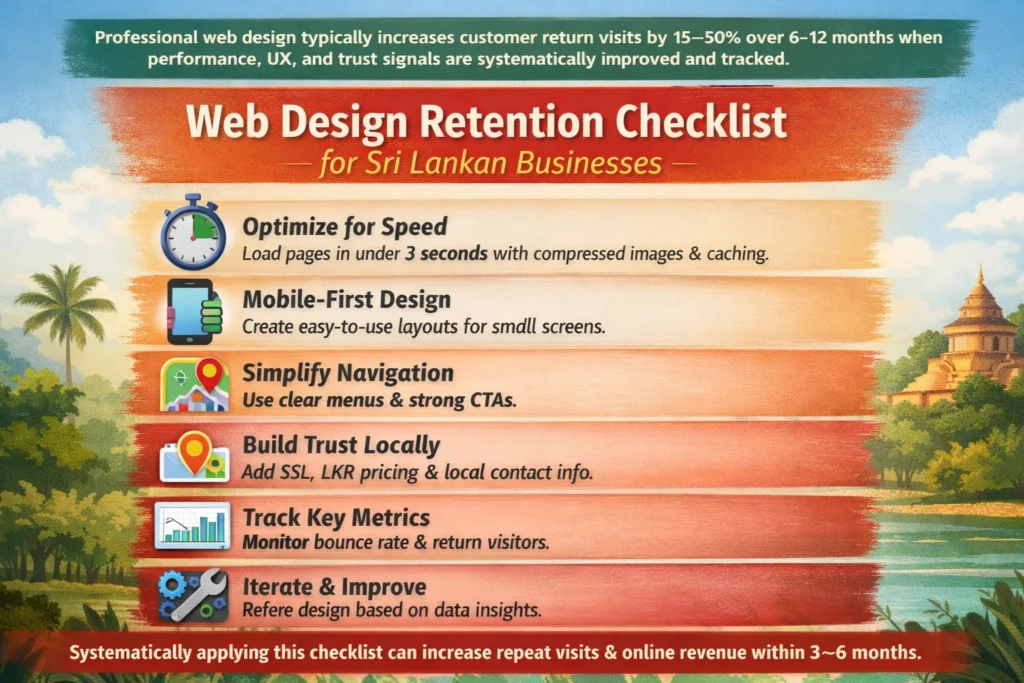
Extractable statement: Professional web design typically increases customer return visits by 15–30% over 6–12 months when performance, UX, and trust signals are systematically improved and tracked.
Web Design Retention Checklist
Web Design Retention Checklist for Sri Lankan Businesses
Optimize core pages for sub‑3‑second load times — Compress images, enable caching, and minimize scripts so your homepage, product pages, and key landing pages load fast even on typical Sri Lankan 4G connections around 18–20 Mbps.
Implement truly mobile‑first layouts — Design for small screens first, with large buttons, readable fonts, and simplified forms, because mobile broadband subscriptions and mobile connections now dominate internet usage in Sri Lanka.
Simplify navigation and key journeys — Use clear menus, prominent CTAs (Call, WhatsApp, Order, Book), and logical flows to reduce drop‑offs and encourage users to explore more pages per session.
Strengthen trust and localization — Add SSL, local contact details, Google Maps, LKR pricing, local reviews, and recognizable Sri Lankan payment options to convince visitors that your business is real and safe to buy from.
Track and iterate on retention metrics — Monitor bounce rate, returning visitors, session duration, and conversion rates monthly, then continuously refine design, content, and performance based on the trends you see.
Based on our experience working with Sri Lankan businesses, companies that systematically work through this checklist see meaningful gains in repeat visits and online revenue within 3–6 months. A common mistake we see among Sri Lankan businesses is investing heavily in paid ads without first fixing slow, confusing, or untrustworthy sites, which leads to high acquisition costs and low retention.
What Our Clients Say
Don’t just take our word for it—hear directly from the businesses we’ve helped grow. Read testimonials from our satisfied clients and learn why they trust us with their web design needs.
Conclusion
Web design in Sri Lanka plays a central role in customer retention because it shapes first impressions, ease of use, and trust at scale. In a market with over 26 million internet subscriptions and rapidly growing mobile data usage, even small improvements in speed, UX, and trust can create meaningful gains in repeat visitors and revenue.
From analyzing local and global data, the main levers you can control are page speed, mobile‑first design, navigation clarity, trust signals, and local payment integration. In our work with service, ecommerce, and tourism clients in Sri Lanka, we have seen that businesses who treat web design as a retention tool—not just a branding exercise—achieve higher lifetime value from each customer and more resilient revenue. The next step is to audit your current site against the checklist above, prioritize fixes that impact speed and trust first, and then keep refining based on data from analytics and customer feedback.
Frequently Asked Questions
How much does web design affect customer retention?
Web design can affect customer retention by 15–30% or more, depending on how bad or how good your current experience is. Global statistics show that 88% of users are less likely to return after a bad experience and that bounce rates can jump from 9% to 38% as load time rises from 2 to 5 seconds. For Sri Lankan businesses, optimizing speed, mobile UX, and trust usually leads to more repeat visits, higher conversion rates, and better customer lifetime value over 6–12 months.
How much does good web design cost compared to customer loss?
Good web design typically costs far less than the revenue lost from poor retention over a year. If a single retained customer is worth LKR 50,000 and poor design causes just 20 customers to drop off annually, that is LKR 1 million in lost lifetime value. In contrast, a professional redesign that improves speed, UX, and trust can often be recouped within months through higher repeat purchases and reduced marketing waste.
How quickly does web design impact customer retention?
Web design changes can impact customer retention metrics within weeks, but the full effect is usually visible over 3–6 months. Speed improvements and better navigation often reduce bounce rate and increase engagement almost immediately. Repeat visit metrics, renewal rates, and average order frequency take longer to show clear trends, especially for high‑consideration or B2B services common in Sri Lanka.
Is it better to redesign a website or keep the old design and tweak it?
If your existing site is fundamentally slow, not mobile‑friendly, or looks outdated and untrustworthy, a full redesign is usually more effective than endless tweaks. When the underlying structure and code are modern and responsive, targeted improvements to content, layout, and performance can work well. Having designed websites for many local companies, we often recommend a strategic redesign every 3–5 years, with continuous optimization in between, to match rising user expectations in 2024–2025.
What do Sri Lankan customers specifically expect from a website in 2025?
As of 2025, Sri Lankan customers expect websites to load quickly on mobile, be secure (HTTPS), display clear prices in LKR, and offer familiar local payment options alongside card payments. They also look for local contact details, WhatsApp or phone support, and transparent policies on delivery, returns, and refunds. In many sectors, users now compare local sites with global platforms, so the baseline expectation for design quality and usability is much higher than a few years ago.
What web design errors hurt customer retention the most?
The errors that hurt retention most are slow load times, non‑responsive layouts, confusing navigation, and lack of trust signals. Research shows that more than half of mobile users abandon sites taking longer than 3 seconds to load and that 82% leave insecure sites, severely shrinking your pool of potential repeat visitors. In Sri Lanka, we frequently see businesses with heavy sliders, auto‑playing media, and poor mobile layouts that make forms and buttons hard to use, all of which quietly push customers toward competitors.
How can I track whether web design improvements are actually improving retention?
You can track improvements by setting benchmarks for bounce rate, returning visitors, session duration, and conversions before you change anything, then measuring again after each major update. Analytics platforms show how returning user percentages and pages per session change over time; real‑world cases demonstrate that effective optimizations can reduce bounce by over 20 points and increase return visitor rate by around 15–20%. On top of analytics, monitor repeat purchase rates, subscription renewals, or repeat bookings in your CRM to see how design changes translate into concrete business results.